
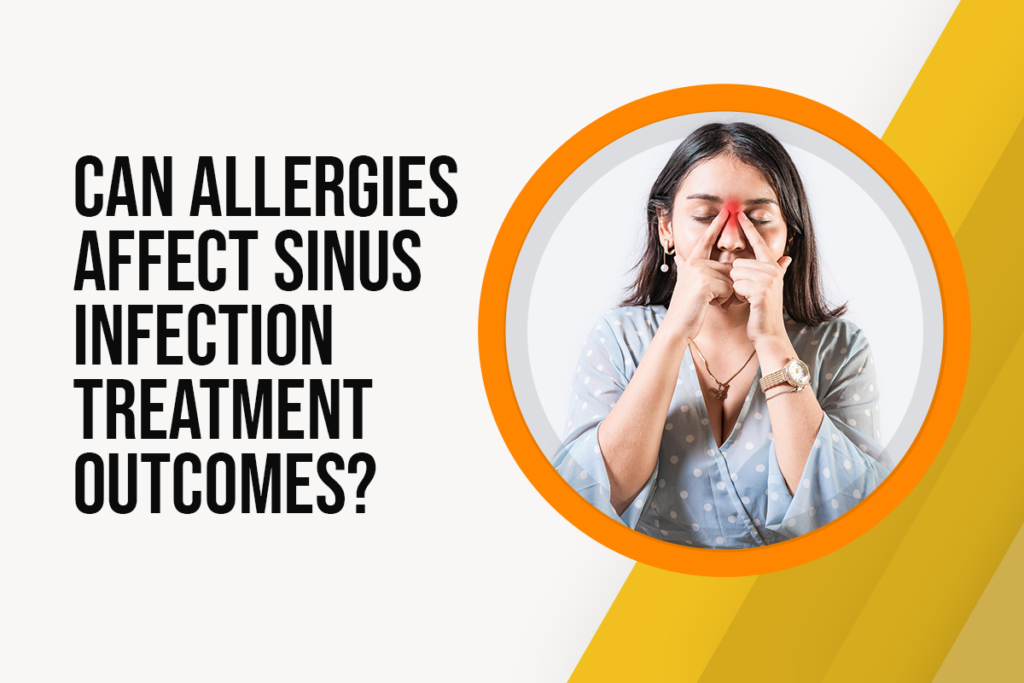
Yes, allergies can significantly affect how well your sinus infection treatment works. When allergies and sinusitis occur together, the allergic inflammation keeps your sinus lining swollen even after the infection is treated. This is why many patients find their sinusitis keeps coming back. Treating only the infection without addressing the underlying allergy often leads to incomplete recovery and frequent recurrence.
Why Allergies Make Sinus Infections Harder to Treat?
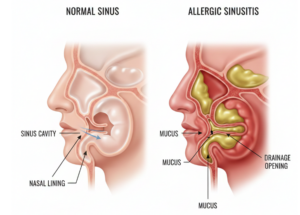
When you breathe in an allergen ,dust, pollen, or mold, your immune system causes the lining of your nose to swell. The tiny drainage openings of your sinuses get blocked. When drainage stops, mucus builds up, and bacteria find the perfect breeding ground. That is sinusitis.
The problem is that this swelling does not go away after the infection clears ,not if you are allergic. Your immune system keeps reacting to allergens long after the bacteria are gone.
Think of it this way: treating sinusitis without managing allergies is like mopping the floor while the tap is still running. You are fixing the symptom, not the cause.
This is exactly what leads to the cycle many patients describe, sinusitis coming back every 2 to 3 months despite taking antibiotics. In most of these cases, unmanaged allergies are driving the recurrence.
Research consistently backs up what we see clinically:
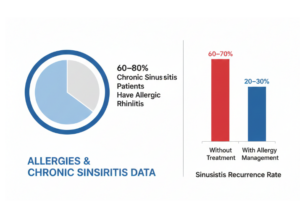
60 to 80 percent of chronic sinusitis patients also have allergic rhinitis. Allergy patients are 3 to 4 times more likely to develop recurrent sinusitis. They also experience symptoms about 35 percent longer than non-allergy patients.
Antibiotic-only treatment is about 40 percent less effective in allergy patients. When allergy is treated alongside the infection, improvement reaches 70 to 80 percent. And about 30 percent of allergic sinusitis patients develop nasal polyps over time if the allergy goes unmanaged.
How Treatment Must Change for Allergy Patients?
Simply prescribing antibiotics is not enough. A proper treatment plan for allergy patients needs to be layered.
- The first step is identifying your allergens through a skin prick test or blood IgE test. Common triggers include house dust mites, mold spores, cockroach allergens, and seasonal pollen from the region’s vineyards and farms.
- Second, intranasal corticosteroid sprays are now the first-line treatment for sinusitis in allergy patients. They reduce inflammation at the source and lower the chance of recurrence with regular use.
- Third, the right antihistamine matters. Older antihistamines like chlorpheniramine dry out mucus too aggressively and can make drainage worse. Newer options like cetirizine or fexofenadine reduce allergic inflammation without causing excessive dryness, a critical difference for sinusitis patients.
- Fourth, a daily saline nasal rinse flushes out allergens, pollutants, and thick mucus.
- Fifth, for patients with severe or year-round allergies, allergen immunotherapy through allergy shots or sublingual drops gradually desensitises the immune system over 3 to 5 years. It is the only treatment that addresses the root cause and can lead to long-term freedom from sinusitis.
- Finally, when scans show significant polyps or structural blockage, sinus surgery may be needed. But surgery without allergy management leads to polyp regrowth. Surgery plus ongoing allergy treatment gives lasting results.

With vs Without Allergy Management
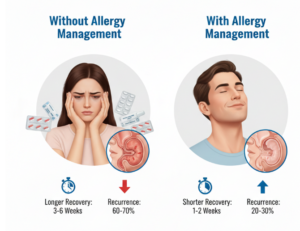
Without allergy management, sinusitis treatment typically takes 3 to 6 weeks or longer, recurs in 60 to 70 percent of patients within 6 months, requires repeated antibiotic courses, gives a poor response to nasal sprays, and almost always leads to chronic sinusitis over time.
With allergy management, treatment often resolves in 1 to 2 weeks, recurrence drops to 20 to 30 percent, fewer antibiotics are needed, nasal sprays work well, and the condition can be fully controlled long-term.
When to See an ENT Specialist?
You should book a consultation if your sinusitis lasts more than 10 days without improvement, returns 3 or more times in a year, comes with persistent nasal blockage or loss of smell, causes headaches that worsen when you bend forward, or seems to be triggered every time your allergies flare up. Children with chronic mouth breathing, snoring, or repeated ear infections alongside sinus symptoms should also be evaluated early.
At our clinic, we do not just treat the current infection. We look at what is driving it, your allergy history, your environment, your previous treatment response, and any structural issues in your nose or sinuses.
Frequently Asked Questions
Why does my sinusitis keep coming back even after antibiotics?
Antibiotics kill the current bacteria but cannot prevent the next infection if your sinuses remain inflamed from allergies. If sinusitis keeps returning, an underlying trigger, most often allergies, is almost always the reason.
Is allergy testing necessary before treating sinusitis?
Not always for the first episode. But if you have had 2 or more episodes in a year, or symptoms don’t clear with treatment, allergy testing is strongly recommended. It changes the entire treatment strategy.
Are nasal steroid sprays safe for long-term use?
Yes. Modern intranasal corticosteroids like fluticasone or mometasone are very safe for long-term use. They work locally in the nose with minimal absorption into the bloodstream.
Can children in Nashik develop allergic sinusitis?
Absolutely. Signs include chronic runny nose, mouth breathing, snoring, dark circles under the eyes, and frequent ear or throat infections. Early treatment prevents long-term complications.
What is the difference between allergic rhinitis and sinusitis?
Allergic rhinitis is inflammation of the nasal lining ,runny nose, sneezing, congestion, but the sinuses may be clear. Sinusitis is infection or inflammation of the sinus cavities themselves, with facial pain, pressure, thick discharge, and sometimes fever. The two frequently occur together.
How long does allergy treatment take to improve sinusitis?
Nasal steroid sprays take 2 to 4 weeks for full effect. Antihistamines often help within a day or two. Immunotherapy takes 3 to 6 months for meaningful improvement and 3 to 5 years for long-lasting results. Patients on successful immunotherapy often go years without a significant sinus infection.
Can food allergies cause sinus infections?
Food allergies are less commonly a direct cause than airborne allergens. However, some patients notice dairy increases mucus production and worsens congestion. If you notice a consistent pattern, it is worth discussing with your ENT specialist.
Can a sinus infection go away on its own if I have allergies?
A mild viral sinusitis may resolve in 7 to 10 days. But in patients with significant allergic inflammation, blockage persists and bacteria can take hold, making spontaneous recovery unlikely. If symptoms do not improve in 10 days, please see a doctor.

Dr. Sudarshen Aahire is a young, talented, and vibrant ENT and Pediatric doctor in Nashik with 12 years of experience. Apart from routine ENT care and surgeries he specializes in the management of Snoring and obstructive sleep apnea surgeries, Endoscopic skull base surgeries, voice-related disorders, and voice surgeries, airway and swallowing disorders.