
Congenital hearing loss refers to hearing loss that is present at birth. It can affect one or both ears and may range from mild difficulty hearing certain sounds to profound hearing loss. Some children with congenital hearing loss have no obvious signs during the first few months, which is why newborn hearing screening and attention to early developmental milestones are important.
Hearing plays an important role in how children develop communication, speech, language, and social skills. Recognizing a possible hearing concern early gives families an opportunity to arrange appropriate evaluation and support.
Key Takeaways
- Congenital hearing loss is present at birth and may affect one or both ears.
- Genetic, prenatal, birth-related, and other medical factors can contribute to it.
- Early signs may include limited response to sounds or delayed communication.
- Newborn hearing screening helps identify hearing concerns early.
- Early identification can support speech, language, and communication development.
- Parents with concerns about their child’s hearing should seek a timely hearing evaluation.
What Is Congenital Hearing Loss?
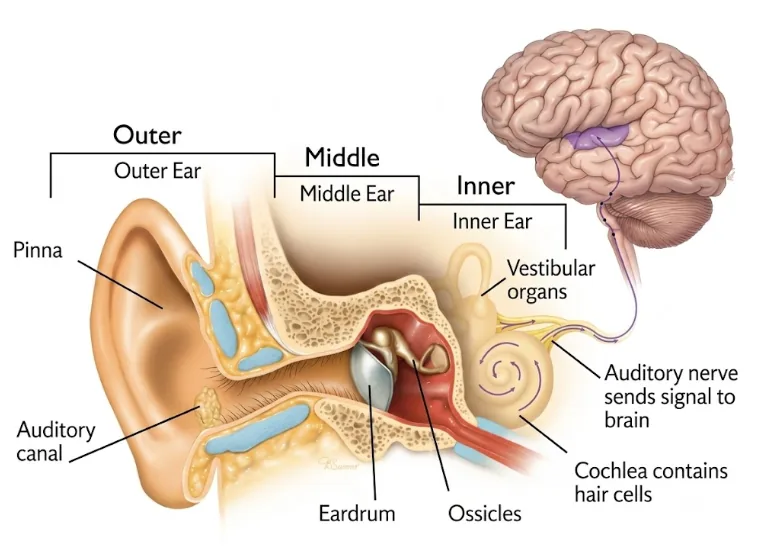
Congenital hearing loss is hearing loss that is present when a baby is born. It may result from changes affecting the outer ear, middle ear, inner ear, hearing nerve, or the way auditory information is processed.
Congenital hearing loss can be classified in several ways. It may be unilateral, affecting one ear, or bilateral, affecting both ears. It can also be stable or progressive, depending on whether hearing remains the same or changes over time.
The severity can vary considerably. Some children may have difficulty hearing softer sounds, while others may have very limited access to speech and environmental sounds.
What Causes Congenital Hearing Loss?
Several factors may contribute to hearing loss that is present from birth. In some children, the cause is genetic, while in others it may be associated with factors affecting pregnancy, birth, or early development. Sometimes, the exact cause cannot be identified immediately.
Genetic Factors
Genetic changes are an important cause of hearing loss in babies and children. Hearing loss may occur as part of a genetic condition or without other noticeable health problems.
A child may have a family history of hearing loss, but this is not always the case. Some genetic changes can occur in a child even when there is no known history of hearing loss in the family.
Infections During Pregnancy
Certain infections during pregnancy can increase the risk of hearing loss in a baby. Congenital cytomegalovirus, commonly known as CMV, is one example associated with childhood hearing loss.
The effect of an infection can vary from child to child, so a history of infection does not automatically mean that a baby will have hearing loss.
Factors Related to Birth and Newborn Health
Some medical circumstances around birth may increase the risk of hearing problems. These can include significant prematurity, certain complications requiring intensive neonatal care, severe jaundice requiring treatment, or other serious medical conditions.
These factors are considered as part of the child’s overall medical and birth history when evaluating hearing.
Other Medical or Structural Factors
Differences in the development of the ear, certain neurological conditions, infections affecting the nervous system, and other medical conditions may also be associated with childhood hearing loss.
Because congenital hearing loss has different possible causes, identifying the underlying reason may require a detailed medical history and, in selected cases, additional investigations.
What Are the Types of Congenital Hearing Loss?
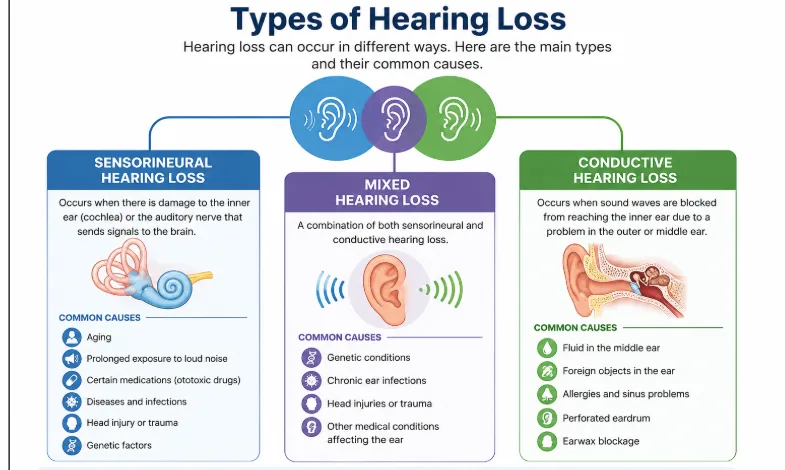
Hearing loss can be classified according to the part of the auditory system involved.
Conductive Hearing Loss
Conductive hearing loss occurs when sound cannot travel normally through the outer or middle ear. Problems involving the ear canal, eardrum, or middle-ear structures can contribute to this type of hearing loss.
Sensorineural Hearing Loss
Sensorineural hearing loss involves the inner ear or the hearing nerve. Congenital sensorineural hearing loss is an important form of permanent hearing loss in children and may have genetic or other medical causes.
Mixed Hearing Loss
Mixed hearing loss contains features of both conductive and sensorineural hearing loss. This means that problems affecting sound transmission and the inner ear or hearing nerve can occur together.
The degree of hearing loss can also vary from mild to profound, and hearing loss may affect one ear or both ears. These differences are important when a child’s hearing is evaluated.
What Are the Early Signs of Hearing Loss in Babies?
Some babies with hearing loss may not show an obvious difference in their behavior. Parents may therefore notice concerns gradually as the child grows.
Possible signs include:
- Not reacting consistently to loud sounds
- Not turning toward sounds as expected
- Not responding when called by name as the child gets older
- Appearing to respond to some sounds but not others
- Delayed babbling or early communication skills
- Turning toward a person only after seeing them rather than responding to their voice
These signs do not automatically mean that a child has hearing loss. However, they are reasons to discuss the child’s hearing and development with a healthcare professional.
How Can Parents Recognize Hearing Problems in Older Children?
As children become more involved in conversation and learning, hearing difficulties may become easier to notice.
Parents or teachers may observe:
- Delayed speech development
- Speech that is difficult to understand
- Difficulty following spoken instructions
- Frequently asking others to repeat themselves
- Frequently responding with “huh?” or similar expressions
- Increasing the volume of the television or other devices
- Difficulty understanding speech when there is background noise
Hearing difficulties can sometimes be mistaken for inattention or behavioral problems. If a child consistently struggles to understand spoken communication, hearing should be considered as one possible factor.
How Is Congenital Hearing Loss Detected?
A newborn hearing screening can help detect possible hearing problems soon after birth. Screening is generally quick, painless, and can often be performed while the baby is sleeping.
Two commonly used screening technologies are otoacoustic emissions (OAE) and automated auditory brainstem response (AABR). These tests assess different aspects of the hearing system and do not require a baby to describe what they can hear.
A screening result is not the same as a complete diagnosis. If a baby does not pass the initial screening, follow-up diagnostic hearing testing is important to determine whether hearing loss is present, its degree, and the type involved.
The commonly used Early Hearing Detection and Intervention framework recommends hearing screening by 1 month, diagnostic evaluation by 3 months when hearing loss is suspected, and appropriate early intervention by 6 months.
Why Is Early Identification Important?
Hearing provides children with opportunities to develop communication and language skills through everyday interactions. When significant hearing loss goes unidentified, a child may miss important opportunities to hear speech and other sounds.
Early identification allows families and healthcare professionals to understand the child’s hearing needs and consider appropriate communication and developmental support. Early access to suitable services is associated with better opportunities for children to develop communication, language, and social skills.
Early identification does not mean that every child will have the same outcome. Each child’s hearing level, underlying cause, development, family circumstances, and communication needs are different.
When Should Parents Consider a Hearing Evaluation?
Parents should consider a hearing evaluation if their baby does not pass a newborn hearing screening or if they notice signs that suggest the child may not be hearing normally.
An evaluation is also appropriate when speech or language development appears delayed, when a child has difficulty following spoken instructions, or when parents have an ongoing concern about hearing.
It is important not to rely only on a child’s response to everyday sounds. Some children with hearing loss can respond to certain sounds while having difficulty hearing speech or softer sounds. A proper hearing assessment provides a clearer understanding of the child’s hearing ability.
Frequently Asked Questions
Can Congenital Hearing Loss Be Prevented During Pregnancy?
Not all cases can be prevented, particularly those caused by genetic factors. However, proper prenatal care, vaccination, infection prevention, and appropriate management of maternal health may help reduce certain risks.
Is Congenital Hearing Loss Always Permanent?
No. The outcome depends on the underlying cause and type of hearing loss. Some hearing problems may be temporary or manageable, while others may be permanent.
Can a Baby Develop Hearing Loss After Passing the Newborn Hearing Screening?
Yes. A baby may develop hearing loss later in childhood even after passing an initial newborn screening. Regular attention to hearing and communication development remains important.
Does Congenital Hearing Loss Affect a Child’s Ability to Learn?
Hearing loss does not mean that a child cannot learn. However, unrecognized hearing difficulties may affect communication and access to spoken information, particularly in learning environments.
Is Congenital Hearing Loss Hereditary?
Some forms of congenital hearing loss are hereditary and can result from genetic changes. However, hearing loss can also occur in children with no known family history.
Can Congenital Hearing Loss Affect Only One Ear?
Yes. Congenital hearing loss can affect one ear or both ears. The degree of hearing loss may also be different in each ear.
What Should Parents Do If They Suspect Hearing Difficulties in Their Child?
Parents should discuss their concerns with a healthcare professional and arrange an appropriate hearing assessment. Timely evaluation can help identify the concern and guide suitable support.